
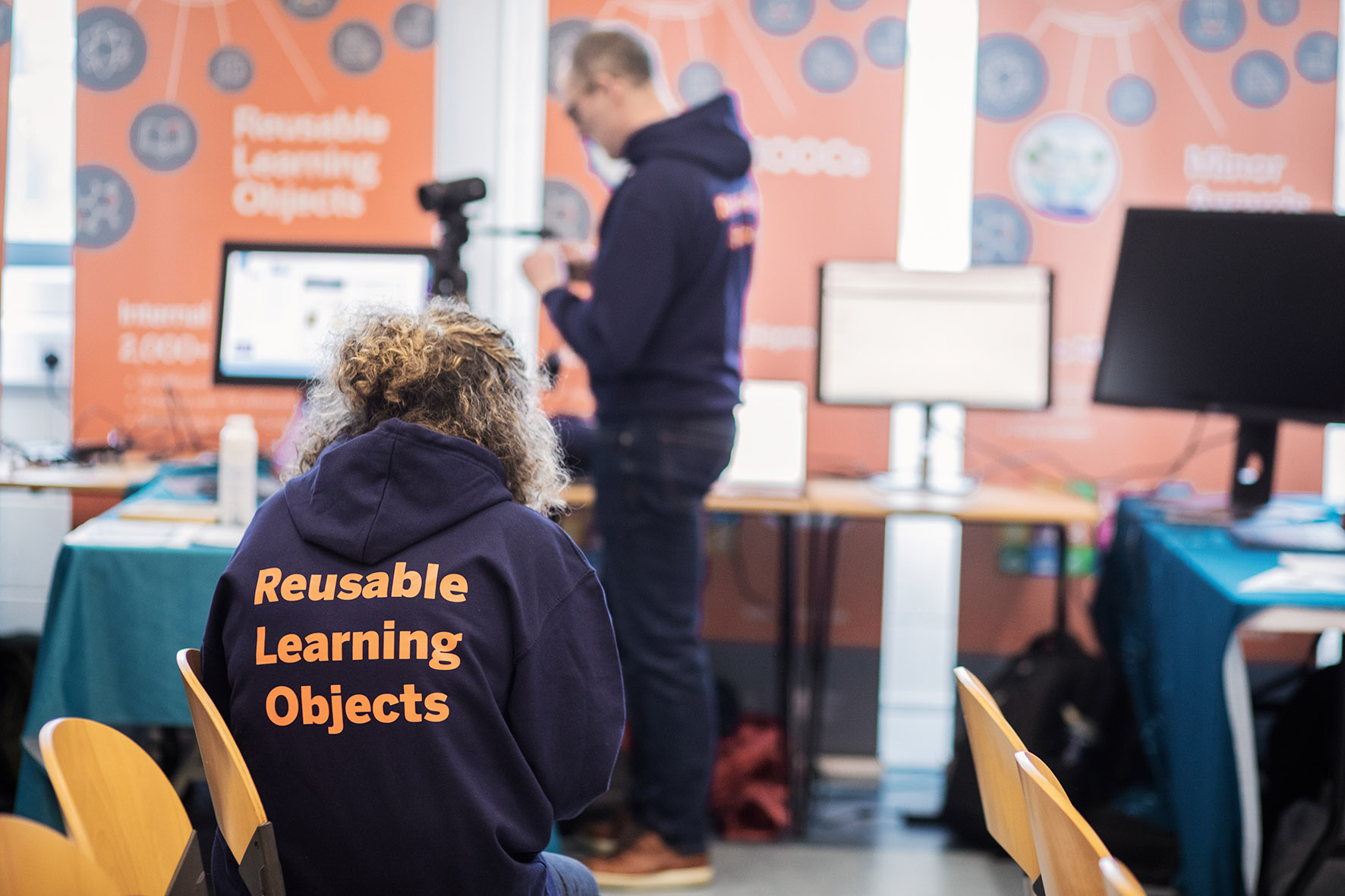
Thousands of RLOs available to ATU lecturers
Reusable Learning Objects refresh old and create new courses
Atlantic Technological University lecturers and staff can now avail of over 5,000 Reusable Learning Objects (RLOs) and Reusable Learning Modules (RLMs) to refresh existing courses or to build new ones.
By creating thousands of RLOs, the Higher Education 4.0 Project, funded by the Human Capital Initiative (HCI) Pillar 3, has been able to produce content and modules that can be used and reused by academic staff across various classes, MOOCs (Massive Open Online Courses), micro-credentials, and full-time and part-time courses.
One Higher Education 4.0 sub-project underlining the value of RLOs and RLMs is the bridging course, Certificate in Computing, which is for students wishing to pursue the MSc in Data Science by combining various modules.
The three RLMs used to create the Certificate in Computing are Database Systems, Applied Statistics, and Programming. In preparation for the higher-level modules, the bridging course is delivered online over a summer semester to provide a foundation for data science students, particularly those who do not have a computing background.
This assists them to transition into computing and be eligible for the MSc in Data Science. By combining these three modules to create the Certificate in Computing, it has opened up data science to a wider audience.

Higher Education 4.0 Innovation Projects Manager Noel Mulkeen
“This concept of RLOs has been around for a while,” says Higher Education 4.0 Innovation Projects Manager Noel Mulkeen, “but through the team’s work on Higher Education 4.0 we have brought it to scale, with over 5,000 learning objects created. Lecturers report substantial time savings, identifying the main benefit to them as being freed up to do other work.”
As a condensed course, it is important that learning material is structured and suitably presented so that learners can progress through various interactive tools to self-assess and manage their learning.
This has been achieved through use of pre-recorded lectures, demonstrations embedded with knowledge checks, short quizzes and supporting links to extension or additional related exercises.
Jennifer Hyndman, ATU lecturer in Applied Statistics, says: “What we identified was that if we offered this course to non-computing participants – accountants, businesspeople or to those from other subject areas or background – what do they need to know? What are the fundamentals they require? What are the concepts they need to be aware of? So, not to have them at a disadvantage.
“We identified Applied Statistics, Programming and Database Systems as key areas, but, individually, they wouldn’t be a full course. However, together they make up the Certificate in Computing, which is simply the bridge into data science.”
The RLOs allow for courses to be self-paced for learners, although these can also be complemented with live lectures. For the computing course, learners do a week of Database Systems, then a week of Applied Statistics, and then two weeks of Programming.

ATU Lecturer in Computing and Programming, Kevin Meehan
Kevin Meehan, ATU lecturer in Computing and Programming, says the RLOs are of “great benefit” to the academic staff. “Higher Education 4.0 gave us a structure, where we had access to the instructional designers,” he begins.
“We were able to get their feedback, and, in turn, they asked us why we were doing things the way that we were and would we consider doing things differently. I didn’t know much about H5P before this, and it basically just opened my eyes to other things.”
H5P, which makes it easy for lecturers to create interactive content such as presentations, videos and other multimedia, questions, quizzes, games and more without the need of programming skills, is used to provide rich HTML5 content with features such as an ‘I’m confused’ button. This enables the lecturer to know specifically which content possibly needs refining and further explanation.
Kevin notes that the uniformity in texture and tone of the RLOs has resulted in “really positive changes”, with content now looking “more professional than they did before”.
He adds: “If you put the time into them, they can be a great resource. If you use them a few times, then you know you’ll make back your time because of the time you’ve spent putting them together. I know from talking to colleagues that there are people doing a lot in this space and creating a lot of RLOs, because you’ll get the benefit out of that.”
ATU lecturer Angela Sweeney, who led out the Database Systems RLM, organised a student survey to secure learners’ feedback on the Certificate in Computing, with responses averaging 5 on a 5-point scale. They strongly agreed that the modules were well prepared, and organised; that each learning content explained new terms, concepts, and principles clearly; and was assessable, stimulating, and challenging.
“The H5P smart import has been a game-changer for me, even with other online modules that I teach,” she said. “So, it has worked out to be a very worthwhile project, because I have used the reusable learning objects time and time again in other modules and other courses.
“H5P integrates quite well with our learning environment. I’d upload the MP4s to H5P and then I’d integrate that into the learning environment. It’s easy, it’s nice, and it’s standardised, and once learners see the first one, they know how it’s structured.”
Having the short bite-size learning sequences developed by the Higher Education 4.0 Instructional Design team enables content to be reused in other related modules, which, in turn, can be used in other disciplines or areas.
YouTube: Reusable Learning Object
Internal SharePoint: Click HERE
For More on RLOs and RLMs: Click HERE

