
Case Study: Ocean Pollution
To tackle climate change we first need an ocean-literate population who understand the essential principles and fundamental concepts about the functioning of the ocean and the challenges that ocean pollution is creating.
The Ocean Pollution MOOC (Massive Open Online Course) is a free short online course intended to be delivered to a wide audience.​
This MOOC promotes sustainable development and circular economy values through literacy around Ocean Pollution. Key topical areas, such as marine litter are presented and discussed. ​
​
The Challenge​
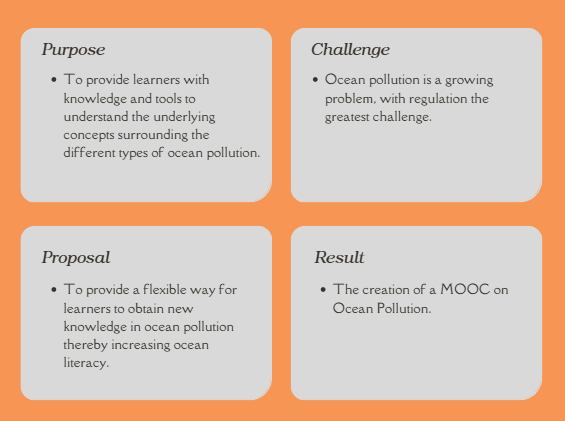
Ocean Pollution is a growing problem with regulation the greatest challenge.​
With almost 40,000 research articles on marine pollution since 1970 the challenge here is to capture the basics of ocean pollution which covers a wide range of diverse topics from hazardous waste to the release of antibiotics .​
Research on marine pollution is rapidly expanding to include heat, noise and light. ​
To provide a flexible way for learners, through applying UDL principles, learners will obtain new knowledge and skills in ocean pollution, thereby increasing ocean literacy for the benefit of society.
The Solution​
Ocean Literacy is a fundamental tool to enhance ocean knowledge, but also to encourage citizens and stakeholders to have an active role in positive change and to reduce ocean pollution. ​
Reducing marine pollution is a global challenge that needs to be addressed, and this can start with reducing pollution at a local scale.​
This can better support ocean sustainability.

The Result​
-
A freely accessible MOOC on Ocean Pollution.​
-
A flexible and self-paced learning opportunity which allows learners to engage with the content to become ocean literate in ocean pollution. ​
-
The MOOC provides supplemental learning to ATU undergraduate courses (e.g., AFMB Degree) and contributes to those interested in lifelong learning. ​
-
Opportunity to help learners decide on a field of study and direct them to potential avenues at ATU for both undergraduate and postgraduate offerings.
Also...​
-
Uptake and engagement on the MOOC - a direct reflection of success​
-
Learner attendance, Completion, and Progress​
-
Learner satisfaction - obtained through feedback survey​
-
Perseverance – learners likely to sign up to another course​
The MOOC will be further promoted through the growing network of ocean literacy advocates in Ireland and abroad, including Waves of Change, as an education tool for ocean literacy.

